
Best Roofing Materials for Northern Michigan: What Actually Lasts
Picking a roofing material in Northern Michigan is different than picking one in Tennessee. Our winters do things to a roof that most manufacturers barely account for in their marketing. Snow loads push 40 pounds per square foot in the Traverse City area. Freeze-thaw cycles happen dozens of times per season. Ice dams form on almost every roof that isn’t properly ventilated.
What works here and what doesn’t? We install all three major roofing types, so we don’t have a reason to push one over another. Here’s what we see on the job.
Asphalt Shingles
The Basics
Asphalt architectural shingles are the most common roofing material in Northern Michigan. About 80% of the residential roofs we replace use them.
Lifespan: 20 to 30 years when installed correctly Cost: $3.50 to $5.50 per square foot installed Best for: Homeowners who want solid performance at the lowest installed cost
The standard products we install are GAF Timberline HDZ and CertainTeed Landmark. Both are architectural shingles, meaning they have a dimensional look and are thicker than old three-tab shingles. They carry manufacturer warranties of 30 years or more, though real-world performance depends heavily on installation, ventilation, and attic insulation.
How They Handle Northern Michigan Weather
Asphalt does fine with cold. The material itself doesn’t crack from freezing. The weak points are wind and ice dams.
Wind: Architectural shingles are rated for 110 to 130 mph winds. That’s adequate for our area. We see blow-offs mainly when the previous installer didn’t nail them in the correct zone or used too few nails. We hand-nail when needed and always follow the manufacturer’s nailing pattern.
Ice dams: Asphalt shingles don’t cause ice dams. Poor attic ventilation and insulation cause ice dams. But when an ice dam does form, water backs up under the shingles and leaks into the house. Ice and water shield along the eaves is the defense. We install it past the interior wall line on every job.
Snow load: Asphalt roofs hold snow. That’s fine structurally as long as the framing is built to code. But it means snow sits on the surface for months, and repeated freeze-thaw cycles work at the edges and seams.
Realistic lifespan here: Expect 20 to 25 years on a properly installed and ventilated asphalt roof in Northern Michigan. Some go longer. South-facing slopes wear faster.
Who Should Choose Asphalt
If your budget for a full replacement is under $15,000 and you want a quality result, asphalt is the move. It’s proven, available, and every roofing contractor in the area knows how to install it. Repairs are simple and affordable if something goes wrong.
Metal Roofing
The Basics
Metal roofing is the premium residential option up here, and it’s growing fast. We install more metal every year.
Lifespan: 40 to 70 years Cost: $8 to $14 per square foot installed Best for: Homeowners who want a roof they’ll never replace again
There are two main types:
Standing seam is the top-tier option. Panels lock together with raised seams and no exposed fasteners. The panels expand and contract freely with temperature changes, which matters in a climate that swings from -10F to 90F. Cost runs $10 to $14 per square foot installed. This is what we recommend for most metal installations.
Exposed fastener panels cost less ($8 to $10 per square foot installed) but have screws that penetrate the surface. Over time, those fastener holes can loosen or leak as the panels expand and contract. They work well for pole barns and outbuildings. For homes, standing seam is worth the upgrade.
How Metal Handles Northern Michigan Weather
This is where metal shines.
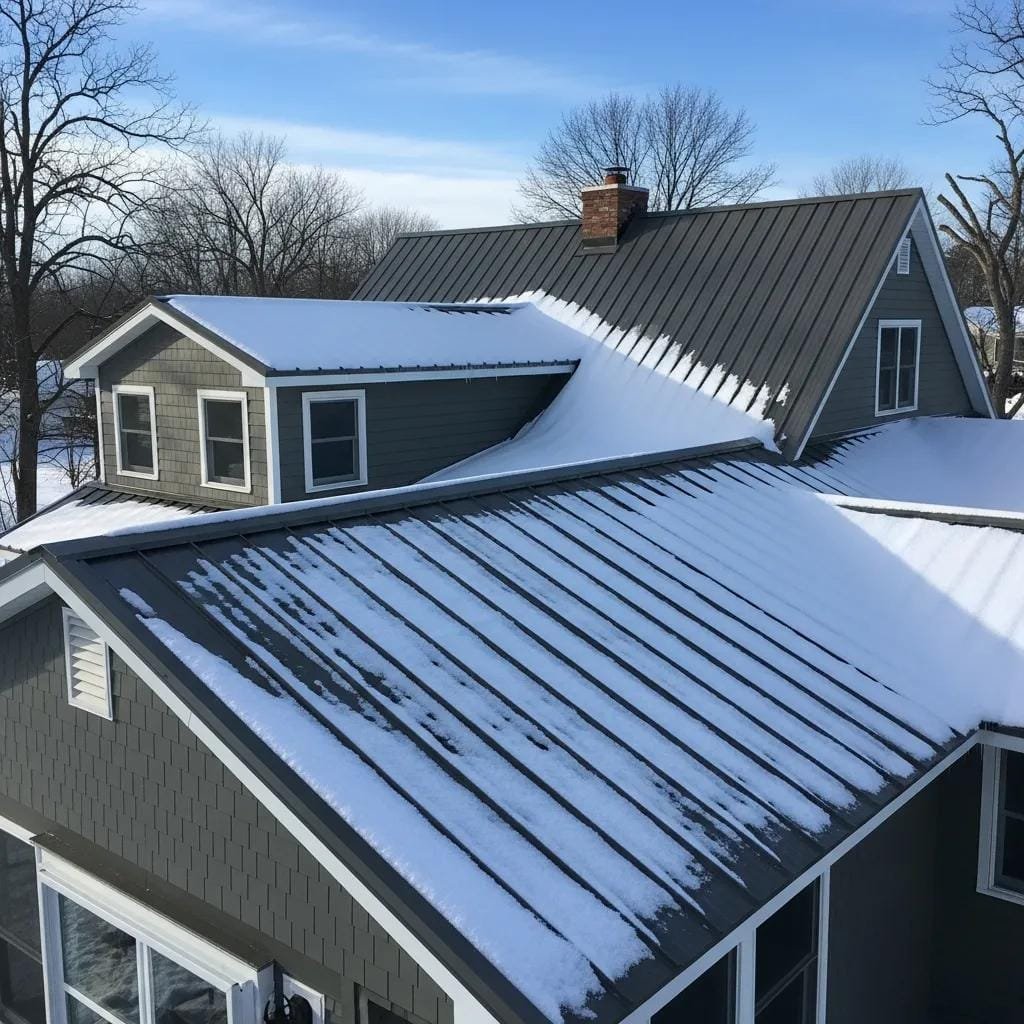
Snow shedding: Metal roofs shed snow. Period. The smooth surface means snow slides off instead of piling up. If you’re tired of ice dams or worried about snow load on an older structure, metal solves that problem. You’ll need snow guards in areas above doorways and walkways so sheets of snow don’t drop on people.
Ice dams: Nearly eliminated on metal roofs because the snow doesn’t sit and melt in layers. Combined with proper ventilation, ice dams are basically a non-issue.
Freeze-thaw: Standing seam panels handle expansion and contraction without any degradation. The hidden fastener system allows the panel to move without breaking a seal. This is a real advantage over 30+ years compared to asphalt.
Wind: Metal roofing handles high winds extremely well. Standing seam systems are rated to 140+ mph. We rarely see wind damage on a properly installed metal roof.
Realistic lifespan here: 50 years is a reasonable expectation for a quality standing seam system with a painted Kynar finish. Some will go 60 or 70 with minimal maintenance.
Gauge Options
Metal panel thickness is measured in gauge. Lower gauge means thicker steel.
26 gauge is the minimum we’ll install on a home. It’s the standard for residential standing seam.
24 gauge is thicker, stiffer, and more dent-resistant. It costs more but handles hail and heavy snow loads better. We recommend 24 gauge for customers who want maximum durability.
Who Should Choose Metal
If you plan to stay in your home for 15+ years and can afford the upfront cost, metal pays for itself. The math works out: a $22,000 metal roof lasting 50 years costs $440/year. A $12,000 asphalt roof lasting 22 years costs $545/year. Metal wins on total cost of ownership.
Metal also makes sense if you’re dealing with recurring ice dam problems or if your home has a steep pitch where snow buildup is a concern.
Flat and Low-Slope Roofing (TPO and EPDM)
The Basics
Flat roofs require completely different materials. You can’t put shingles on a flat roof. The two main options are TPO (white thermoplastic) and EPDM (black rubber).
Lifespan: 15 to 25 years Cost: Varies widely by project size and access Best for: Commercial buildings, modern home designs, additions with low-slope sections
TPO is a white membrane that reflects heat and welds at the seams with hot air. It’s the current industry standard for commercial flat roofing. Seams are strong and watertight when done correctly.
EPDM is a black rubber membrane that’s been around for decades. It’s cheaper and simpler to install. Seams are glued or taped rather than welded. EPDM works well but the seams are its weak point over time.
How Flat Roofing Handles Northern Michigan Weather
Snow load: This is the main concern. Flat roofs don’t shed snow at all. The structure has to carry the full weight of accumulated snow through the winter. In the Traverse City area, that’s a design load of 40 pounds per square foot. Your building has to be engineered for it. Most commercial buildings are. Some residential additions are not, and that’s a problem we flag during inspections.
Ponding water: Flat roofs should drain, but “flat” really means “slightly sloped.” If your flat roof has areas where water ponds after rain and sits for days, that section will fail early. Proper installation includes tapered insulation to create drainage paths.
Freeze-thaw: Both TPO and EPDM handle freeze-thaw well. They’re flexible membranes that don’t crack from temperature cycling.
Who Should Choose Flat Roofing
You don’t usually choose flat roofing. Your building design requires it. If you have a flat or low-slope section, TPO is the better long-term choice for our climate because of the welded seams. If budget is tight and the area is small, EPDM is a solid option.
Decision Framework
If your priority is budget: Go with asphalt architectural shingles from GAF or CertainTeed. You’ll get 20+ years from a quality installation, and you’ll spend $8,000 to $15,000 instead of $15,000 to $30,000. Put the savings toward proper attic ventilation and insulation to prevent ice dams.
If your priority is longevity: Go with standing seam metal in 24 or 26 gauge. You’ll pay more now but you’re done roofing this house. One and done. The snow shedding and ice dam prevention are bonus benefits.
If your priority is resale value: Either option adds value. Metal roofing has a slight edge in perceived value and curb appeal. But a new asphalt roof with a transferable warranty is a strong selling point too. Don’t over-invest in the roof if you’re selling within 5 years.
If you have recurring ice dam issues: Metal is the answer, combined with addressing the underlying ventilation problem. Shingles alone won’t fix ice dams.
What We Recommend
There’s no single “best” material. There’s the best material for your situation.
We install all three types and we’re happy to walk through the pros and cons for your specific home. We’ll look at your roof’s pitch, your budget, how long you plan to stay, and any problems you’ve been dealing with.
The right material is the one that solves your actual problem at a price you can afford.
Get a free estimate and material recommendation for your home.
Have questions about your roof?
We're happy to help. Give us a call or request a free estimate online.