
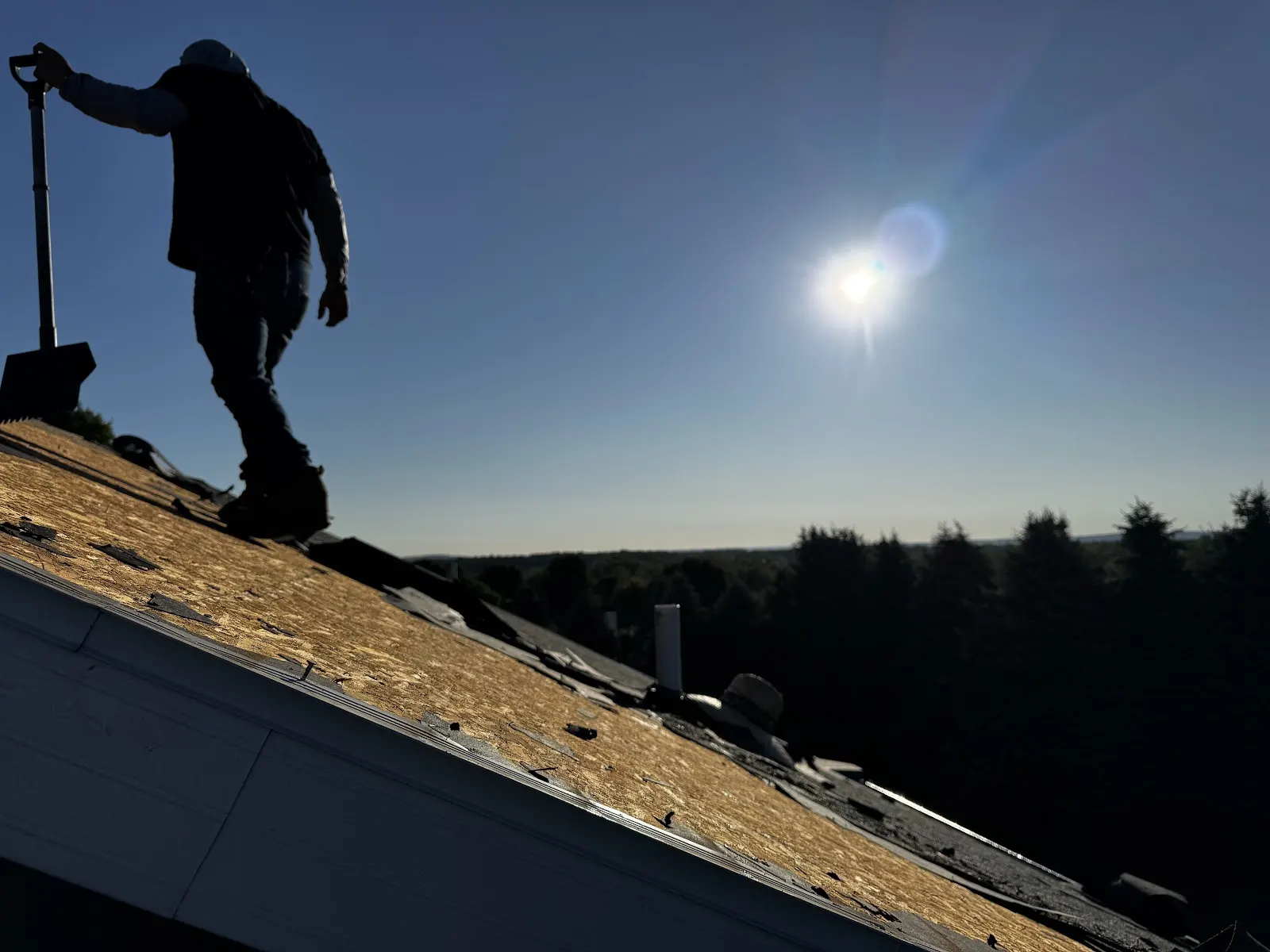
9 Signs You Need a New Roof in N. Michigan
Most homeowners don’t replace their roof until water shows up on the ceiling. By then it’s too late to save much. You’re already paying for drywall, insulation, and sometimes framing on top of the new roof. The replacement was inevitable. The interior damage wasn’t.
The signs that you need a new roof show up months or years before the leak. These are what we look for on inspections, and how the climate up here in Northern Michigan tends to speed up every one of them.
How to Tell If You Need a New Roof: 9 Warning Signs
If you can check off two or three of these, it’s time for a free inspection. Three or more usually means a replacement isn’t far off.
- The roof is past its expected lifespan
- Shingles are curling, cracking, or missing
- You’re finding granules in the gutters
- You can see daylight in the attic
- The roof deck is sagging or feels soft
- There are stains on interior ceilings or walls
- Flashing around chimneys, vents, or skylights is failing
- Moss, algae, or rot is visible from the ground
- You’ve had repeated repairs in the last few years
1. Your Roof Is Past Its Expected Lifespan
Age is the biggest predictor of whether you need a new roof. Every roofing material has an expected service life:
- 3-tab asphalt shingles: 15–20 years
- Architectural (dimensional) shingles: 25–30 years
- Standing seam metal: 40–70 years
- Flat roofing (TPO/EPDM): 20–30 years
- Cedar shake: 20–40 years
For a fuller look at how each of those materials actually ages in this climate, see our guide to the best roofing materials for Northern Michigan.
How long do asphalt shingles last?
Most asphalt shingles installed in the last 15 years are architectural (dimensional), rated for 25 to 30 years. The older 3-tab shingles you’ll find on homes built in the 1990s or early 2000s typically last 15 to 20 years. In Northern Michigan, plan on the lower end of those ranges. Lake-effect snow, freeze-thaw cycles, ice damming, and high wind all wear shingles faster than the same product would wear in a milder climate. We commonly see 25-year shingles fail at 18 to 20 years here, and 20-year shingles fail at 15.
If you don’t know how old your roof is, check the closing documents from when you bought the house, or look for a permit record with the county. If you’ve owned it longer than the expected lifespan, assume the clock is ticking and book an inspection.
2. Shingles Are Curling, Cracking, or Missing
Healthy asphalt shingles lay flat against the roof deck. As they age, the asphalt dries out and the corners start to curl up or cup down. Cracks form across the surface. Tabs blow off in storms.
You can usually see this from the ground with a pair of binoculars, especially on the south- and west-facing slopes that get the most sun. If more than 10 to 20 percent of the visible shingles are curling or cracked, you’re looking at a full replacement, not patching.
3. You’re Finding Granules in the Gutters
Asphalt shingles are coated with mineral granules that protect the underlying asphalt from UV damage. As the shingles age, those granules wear off and wash down into the gutters. A handful of granules from a new roof is normal. That’s just settling. But if you’re cleaning out a half-inch of grit every fall, your shingles are losing their protective layer.
Once the granules are gone, the asphalt below dries out fast and shingle failure accelerates. Granule loss is one of the earliest warning signs you need a new roof.
4. You Can See Daylight in the Attic
Go into your attic on a bright day and turn off the light. If you can see any daylight coming through the roof deck, you have a problem. Even pinhole-sized openings let water in during heavy rain or driving snow.
While you’re up there, check for:
- Water stains on the underside of the deck
- Soft spots or sagging between rafters
- Mold or mildew on the framing or insulation
- Daylight around vent stacks, chimneys, or skylights (usually a flashing issue, but sometimes a sign of bigger deck problems)
In Northern Michigan homes especially, attic moisture is also a sign of ventilation problems. Bad ventilation is one of the fastest ways to kill a roof from the inside. The same imbalance is what drives ice dams every winter.
5. The Roof Deck Is Sagging or Feels Soft
Stand back from your house and look at the rooflines. They should be straight. Any visible dips, waves, or sags in the deck mean the sheathing underneath is failing, usually from water that’s been getting in for years.
If you walk on the roof and it feels soft or spongy underfoot, the deck is rotting. At that point you don’t just need new shingles. You need new sheathing, which adds a day of labor and a few thousand dollars to the job.
We don’t recommend climbing up to check this yourself. Have a professional do it. Soft decking can give way under a person’s weight.
6. Stains on Interior Ceilings or Walls
Brown rings on the ceiling, peeling paint at the top of a wall, or musty smells in upstairs rooms all point to water coming in from above. Sometimes the stain is small enough that you can patch the source and move on. More often, by the time the stain shows up indoors, the leak has been getting bigger for months.
The tricky part about ceiling stains is that water rarely shows up directly below where it entered the roof. It travels along rafters and the underside of the deck before dropping. So the stain on your ceiling might be five or ten feet from the actual hole. That’s why DIY roof patching usually fails. Homeowners patch the spot above the stain instead of the actual entry point. Our guide to why your roof is leaking covers the common sources and how to trace them.
7. Flashing Around Chimneys, Vents, and Skylights Is Failing
Flashing is the metal that seals the joints where the roof meets a chimney, sidewall, vent stack, or skylight. It’s the most common point of failure on a roof, especially on Michigan homes with brick chimneys.
Signs of failing flashing:
- Visible rust on the metal
- Cracked tar or caulk at the seams
- Stains on the wall below the flashing
- Step flashing pulling away from the siding
Sometimes flashing can be replaced without a full roof tear-off. But if the surrounding shingles are also at end of life, it usually makes more sense to do both at the same time.
8. Moss, Algae, or Visible Rot from the Ground
Black streaks on the roof are usually algae. Cosmetic, but a sign the shingles are holding moisture. Moss is worse. It lifts shingles from underneath, lets water work its way under the tabs, and traps moisture against the deck. In Northern Michigan, the north-facing slopes that don’t dry out fully are the most prone to moss growth.
If you can see green clumps growing on the roof from the driveway, the shingles underneath are absorbing water they shouldn’t be. That accelerates rot in the underlying decking.
9. You’ve Had Repeated Repairs in the Last Few Years
A roof that needs three or four repairs in a five-year span is telling you something. The repairs aren’t fixing the problem. They’re delaying it. Each new repair only buys you a few more storms before the next leak appears somewhere else.
If you’ve spent $1,500 to $3,000 on repairs in recent years on a 20-year-old roof, that money would have been better spent toward a replacement. We tell homeowners this honestly even when it costs us a repair job.
How Often Should You Replace a Roof?
When it stops doing its job, not on a calendar.
In a mild climate, a properly installed 30-year architectural shingle roof might actually last close to 30 years. In Northern Michigan, plan on 20 to 25 years for the same product. The combination of UV from summer sun reflecting off the lakes, freeze-thaw cycles, snow load, and ice damming all shorten that window.
Metal roofs are a different conversation. A quality standing seam metal roof installed correctly can last 50 years or more, which usually makes it the last roof you’ll buy for the home. The trade-off is the upfront cost, which runs about double a comparable asphalt roof. We compare the two head-to-head in our guide on metal vs. asphalt roof lifespan.
Flat or low-slope roofing (TPO, EPDM) is the most weather-sensitive. Plan on 20 years and don’t be surprised if you’re replacing it at 17 or 18 in our climate.
When to Replace a Roof vs. Repair It
Rule of thumb: if the roof is in the last quarter of its expected life and you have an active leak, replace. If it’s in the middle of its life and the damage is localized (one storm-damaged area, a single flashing problem), repair.
The decision usually comes down to three factors:
- Age. Anything over 20 years for asphalt is a strong replacement signal.
- Extent of damage. Isolated to one slope? Repairable. Multiple slopes? Replace.
- What’s underneath. If the deck or flashing is compromised, a repair only delays the inevitable. When replacement is the answer, here is how long the process actually takes.
A free inspection makes this clear. We can usually tell you within 20 minutes on the roof whether you’re looking at a $400 patch, a $2,000 partial repair, or a full replacement. Our Traverse City roof cost guide gives you the price ranges ahead of time.
What to Do Next
If you’ve checked off two or three signs from this list, or if you just can’t remember the last time anyone looked at your roof, book a free inspection. We’ll climb up, walk the whole roof, and give you straight answers about how much life you have left. If replacement is the right move, our new roof installation guide explains every step of the process.
We don’t sell roofs that don’t need replacing. If you’ve got five good years left, we’ll tell you. If you’re one storm away from a leak in your bedroom, we’ll tell you that too.
Call us at 231-233-3530 or request a free estimate online. We handle roof replacement in Cadillac, Kingsley, Lake Ann, and the surrounding Northern Michigan area.

About the author
Seth Harris | Owner, Falcon Roofing
Seth Harris is the owner of Falcon Roofing and has worked in the roofing industry for over 20 years. Born and raised in Northern Michigan, he knows firsthand what our climate does to a roof, from heavy snow and ice dams to the freeze-thaw cycles that wreck poorly installed systems. He is personally involved in every project, from the first inspection to the final walkthrough.
More about Seth →Have questions about your roof?
We're happy to help. Give us a call or request a free estimate online.