
How to Choose a Commercial Roof in Northern Michigan: TPO vs. EPDM vs. Metal
Most of our commercial calls start the same way. A property manager or business owner walks into the office after a thaw, having just found a stain spreading across a drop ceiling or a tenant complaining about a drip over their inventory. By the time water shows up inside a commercial building, the roof has usually been failing quietly for a while, and the question quickly becomes what to replace it with.
Choosing a commercial roof in Northern Michigan is not like picking shingles for a house. Most commercial roofs are flat or low-slope, they carry rooftop equipment, and they take a beating from our winters in ways a steep residential roof never does. TPO, EPDM, modified bitumen, and standing seam metal each behave differently up here. This guide walks through how we help Traverse City building owners choose the right system, what each one costs, and how to know whether you need a repair or a full replacement. When you are ready to talk specifics, our commercial roofing services page covers how we handle the work.
Why Commercial Roofs Fail Differently Here
A steep shingle roof sheds water and snow by design. A flat or low-slope commercial roof does not. Water sits, snow piles up, and every seam, drain, and penetration becomes a place a leak can start. In our climate that is a real problem for a few reasons.
- Ponding water. Low-slope roofs are supposed to drain, but over the years the deck sags, insulation compresses, and low spots start holding water. Standing water accelerates membrane breakdown and adds weight.
- Snow load. A flat commercial roof in Grand Traverse County can hold a heavy, wet snowpack for months. That is dead weight on the structure and on every seam.
- Freeze and thaw. Water works into a seam or a flashing detail, freezes, expands, and pries it open a little more every night. By spring, a pinhole is a leak.
- Rooftop traffic. HVAC units, exhaust fans, and the techs who service them all live on a commercial roof. Foot traffic and equipment vibration wear a membrane down around every penetration.
The takeaway is simple. On a commercial building, the roof system and the details matter more than the brand name on the box.
The Commercial Roofing Systems We Install
There is no single best commercial roof. The right system depends on your building, your slope, your budget, and how long you plan to own the property. These are the systems we install most often on the commercial buildings we work on around Traverse City.
TPO (Single-Ply Membrane)
TPO is the most common flat-roof system we install on commercial buildings today, and for good reason. It is a single-ply membrane, usually white, with heat-welded seams that fuse into one continuous surface. The white surface reflects sunlight, which helps with cooling load in summer, and the welded seams hold up far better than the old glued laps ever did.
We install TPO from proven manufacturers like GAF, Carlisle, and Holcim (formerly Firestone). Thickness matters here. A 60-mil membrane will outlast a thin 45-mil budget product, and on a roof that has to survive our winters, the extra thickness is worth every penny. TPO is usually where we start on the flat and low-slope buildings covered on our commercial flat roofing page.
EPDM (Rubber Roofing)
EPDM is a black rubber membrane that has been on commercial buildings for decades, and there is a reason it is still around. It is durable, it stays flexible in cold weather, and it has one of the longest track records of any flat-roof system. The black surface actually works in your favor in Northern Michigan, because it absorbs heat and helps shed snow and ice a little faster than a white roof.
For a building where longevity matters more than summer cooling, EPDM is often the right call.
Modified Bitumen and Built-Up Roofs
On certain low-slope buildings, especially older ones or roofs that take a lot of traffic, a multi-ply modified bitumen or built-up system still makes sense. These are layered, redundant systems. If one layer takes damage, the others are still protecting the building. They are heavier and more labor-intensive, but they are tough.
Standing Seam Metal
Not every commercial building is flat. For sloped commercial roofs, storefronts, and buildings where the owner wants the roof to be the last one they ever buy, we install standing seam metal. It sheds our snow, it lasts 50 years or more, and it has no exposed fasteners to back out over time. It costs more up front, but on the right building it is the best long-term value we can put down. If you are weighing lifespan against cost, our breakdown of metal versus asphalt roof lifespan covers the same math that applies to commercial metal.
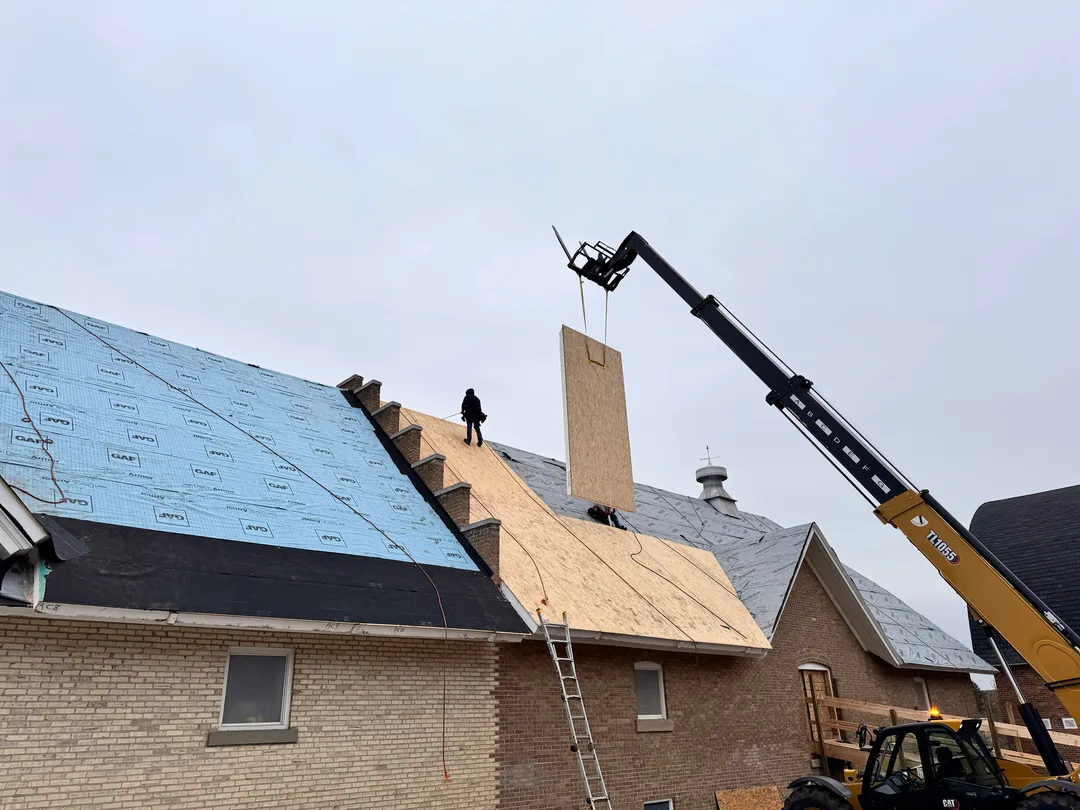 A large commercial re-roof in progress with a telehandler staging materials and GAF underlayment down.
What Drives Commercial Roofing Cost
Commercial roofs are priced by the square foot, not by the “square” the way a house is (our Traverse City roof cost guide explains how residential pricing works). The range is wide because no two buildings are the same. Here is what moves the number.
- Size and access. A 5,000 square foot roof over a single-story shop is very different from a 20,000 square foot roof on a three-story downtown building where every pallet of material has to be lifted up. Access drives labor.
- Tear-off versus recover. Michigan code allows some buildings to take a second membrane over the first, which saves on tear-off and disposal. But if the existing roof is wet or already has two layers, it all has to come off. We do not recover a roof with trapped moisture, because you are just paying to bury a problem.
- Insulation and tapered systems. A full replacement is your chance to add insulation and build in proper slope with tapered insulation so water actually drains. That adds cost, but it fixes ponding for good and lowers heating bills.
- Penetrations and details. Every HVAC curb, drain, vent, and parapet wall is a spot that has to be flashed by hand. A cut-up roof with a lot of equipment costs more per square foot than a wide-open one.
- Code and energy requirements. Michigan’s commercial energy code sets minimum insulation values on a full roof replacement. That is not optional, and a bid that ignores it is not a real bid.
As a rough range, a quality single-ply commercial system in our area usually lands somewhere between $6 and $12 per square foot installed, depending on everything above. Metal runs higher. The only way to get a real number is to get on the roof, measure it, and look at what is underneath.
Repair, Replace, or Restore?
Not every commercial roof needs to be torn off. Part of our job is telling you honestly which of the three you are actually looking at.
- Repair makes sense when the membrane has plenty of life left and the problem is localized, like a failed seam, a cracked pipe boot, or storm damage in one area.
- Restoration, meaning a roof coating over a sound membrane, can buy years on a roof that is aging but not failing. It is not a fix for a wet or shot roof, and we will tell you if a coating would just be lipstick. But on the right roof, at the right time, it is a legitimate way to stretch your capital.
- Replacement is the answer when the membrane is at the end of its life, there is trapped moisture in the insulation, or you are chasing leaks every spring. At that point, patching is throwing good money after bad.
A good commercial roofer should be able to walk your roof, run a moisture scan if needed, and give you a straight recommendation, not just quote the biggest job on the board.
Flat Roofs and Northern Michigan Snow
This is the part out-of-town contractors underestimate. A flat roof in Traverse City has to handle a snow load that a flat roof downstate simply does not. Wet, heavy snow sits for months, drains freeze shut, and meltwater backs up with nowhere to go.
That is why drainage is everything on a commercial roof here. We look hard at whether water actually reaches the drains, whether the drains are sized correctly and clear, and whether a tapered insulation system would solve chronic ponding. We also pay attention to the snow load on the structure itself, and we flag it when a roof is holding water it should be shedding.
Permits and Michigan Commercial Code
Commercial reroofs in Grand Traverse County require a permit, and commercial work is held to a stricter standard than residential. That covers fire ratings on the assembly, minimum insulation values under the energy code, and how the system is fastened for wind uplift. Any reputable commercial contractor pulls the permit and builds to code. If a bid is suspiciously cheap and skips the permit conversation, take that as your warning sign.
How We Approach a Commercial Roof
Commercial work is different from a house because the building usually cannot shut down while we work. Our process is built around that.
We start with a real inspection, including a moisture check where it matters, so we know what is under the membrane before we quote. We give you a written scope that spells out the system, the insulation, the details, and the warranty, the same standard we hold every quality installation to. On an occupied building, we phase the work and protect the interior so your business or your tenants keep running. And we stand behind both the manufacturer’s material warranty and our own workmanship.
Questions to Ask Before You Sign
If you are collecting commercial roofing bids in the Traverse City area, these questions separate the real contractors from the cheap ones.
- What system and thickness are you installing, and why that one for my building?
- Are you tearing off or recovering, and did you check for moisture in the existing roof?
- Does the bid meet Michigan’s energy code for insulation?
- How are you handling drainage and ponding?
- What does the warranty cover, material and workmanship both?
- Are you pulling the permit?
A contractor who answers those clearly is one you can trust on the roof.
Talk to Falcon About Your Commercial Roof
We have been installing commercial roofing around Traverse City, commercial roofing in Petoskey, Cadillac, and Northern Michigan for years, from storefronts and offices to larger flat-roof buildings. If you are dealing with a leak, chasing ponding water, or just trying to plan for a roof that is near the end of its life, we will get up there, tell you honestly what you are looking at, and put a written estimate in your hands. No pressure, and no selling you a tear-off you do not need.

About the author
Seth Harris | Owner, Falcon Roofing
Seth Harris is the owner of Falcon Roofing and has worked in the roofing industry for over 20 years. Born and raised in Northern Michigan, he knows firsthand what our climate does to a roof, from heavy snow and ice dams to the freeze-thaw cycles that wreck poorly installed systems. He is personally involved in every project, from the first inspection to the final walkthrough.
More about Seth →Have questions about your roof?
We're happy to help. Give us a call or request a free estimate online.